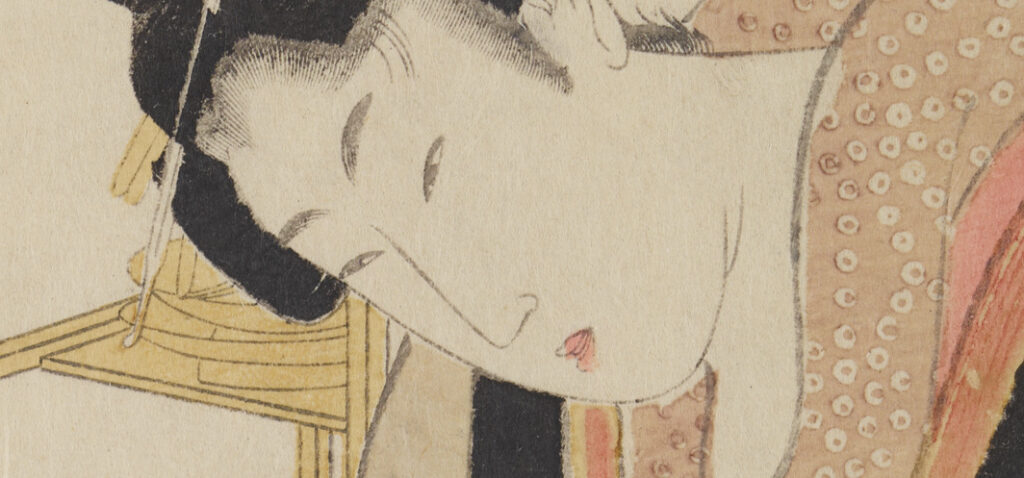
The National Museum’s Far Eastern collection began with a gift from Wiktor Osławski in 1892 – two Japanese vases depicting scenes of silk production. Japanese art still occupies a unique position in the collection, which comprises over 12,600 objects, also originating from China, Korea, Mongolia, Tibet and, to a lesser extent, India and Indonesia.
The largest and most cohesive group is Japanese art, particularly prints from the ukiyo-e school (over 4,600 plates, illustrated books and albums) from the collection of Feliks Jasieński. The greatest masters of Japanese colour woodblock printing from the 17th to the 19th century are represented here, including: Suzuki Harunobu, Isoda Koryūsai, Torii Kiyonaga, Kitagawa Utamaro and Toshūsai Sharaku.
Notable figures from the Utagawa school include Toyokuni, Kuniyoshi and Hiroshige. Katsushika Hokusai deserves special mention; he is the author of, amongst other works, the ‘Manga – Miscellaneous Sketches’ pattern books, from which Feliks Jasieński drew inspiration for his pseudonym, Manggha. The second largest and most artistically valuable collection of Japanese artefacts consists of military items, including around 50 swords (katana, wakizashi, tachi), several of which are of the highest artistic quality, as is the collection of helmets, masks and armour. Of particular significance is the collection of over 750 tsuba (sword guards) and decorative sword hilt fittings.
The interesting collection of Japanese lacquerware comprises inrō medicine boxes with decorative netsuke pendants from the 18th–19th centuries, as well as various types of caskets, bowls, tables, combs, etc. Among the Japanese textiles, particular attention is drawn to a collection of 30 obi sashes, kimonos and tapestries, mostly from the 18th and 19th centuries. The collection of Japanese ceramics includes late 19th-century pieces produced for export to Europe.
The collection of Japanese art is complemented by paintings on silk and paper, the earliest of which date from the 17th century. Japanese sculpture is represented by bronze and wooden figures of deities, as well as small ivory carvings, the so-called netsuke and okimono. Among other works of applied art, cloisonné pieces, artistically woven baskets and musical instruments are worth mentioning.
Within the collection of Chinese art, the collection of ceramics, comprising around 400 objects, including a donation from Prof. Julian Nowak, deserves special attention. These are works created from the Han dynasty to the Qing dynasty (2nd century BC – 19th/20th century). Chinese textiles include men’s and women’s garments, so-called mandarin emblems, tapestries and fragments of embroidery, mostly from the 18th and 19th centuries. A small collection of jade, enamel and ivory carvings dates from the late Qing Dynasty, as do a dozen or so polearms and swords.
Before the Second World War, the Oriental artefacts from Jasieński’s collection were exhibited several times by the National Museum. In 1934, a permanent exhibition of his collection was opened at the Feliks Jasieński MNK Szołayski House, presenting a selection of the items donated to the Museum. In the post-war period, exhibitions were organised both domestically and abroad, including in Germany, Japan, Hungary and Belgium. Almost all exhibitions were accompanied by catalogues authored by the Department’s curators and specialists collaborating with them. Alongside exhibition activities, lectures, research and initiatives promoting the MNK’s Far Eastern collections are conducted both domestically and abroad.
In 2005, the collection was taken into deposit by the Manggha Centre for Japanese Art and Technology (since 2008, the Museum).
The collection continues to be catalogued by curators of the National Museum in Kraków and remains under the constant care of the National Museum’s conservation workshops.
Compiled by: Beata Romanowicz, Curator of the Far Eastern Art Department
Head: Beata Romanowicz – tel. +48 12 4335 471