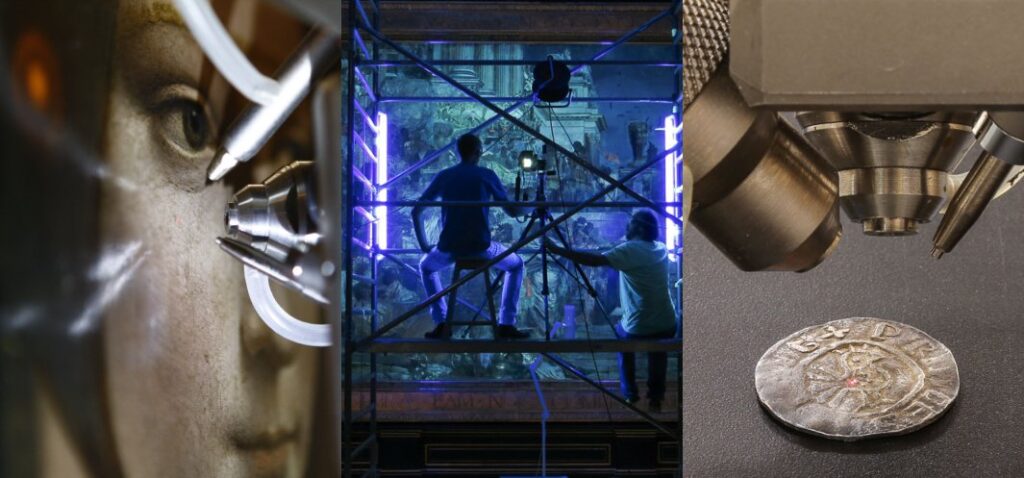
The Laboratory of Analysis and Non-Destructive Investigation of Heritage Objects (LANBOZ) was established in 2004, as the first – and so far unique – museum facility of its kind in Poland. The laboratory conducts specialized technical research on cultural heritage objects and implements a program of basic research that has the goal of obtaining a better of understanding of the materials and methods used to create a wide variety of objects. In 2007, the Museum took the ambitious initiative to expand its activities and transform LANBOZ into a modern scientific unit, conducting specialized research of world renown, inspiring cooperation with research groups outside the Museum, disseminating knowledge and training young researchers and conservators. In line with this new strategy, collaboration with science specialists wasinitiated, with intensive and successful research projects and the development of national and international collaborations. Over the past 15 years, LANBOZ has carried out numerous national and European Union research projects, obtained external funding amounting to 6 milion PLN, created a robust analytical laboratory equipment platform – unique in the country, increased the employment of staff with high research qualifications, and established a network of contacts with important research and museum institutions around the world.
LANBOZ conducts research on the materials and techniques used to create cultural heritage objects, supporting historical analyses or expert opinions on the authenticity of works of art conducted by art historians, archaeologists, and/or conservators. LANBOZ investigates the material aspects of works of art from the National Museum’s collection as well as other collections housed in Polish museums. The laboratory is equipped with technical photography, X-radiography, electron microscopy, Raman and infrared spectroscopy, and imaging X-ray fluorescence spectroscopy, among other techniques. A comprehensive research program involving imaging, microscopy and spectroscopy was implemented in 2012 to better understand the technical aspects of the painting Lady with Ermine by Leonardo da Vinci from the collection of the National Museum in Krakow. The painting was examined using state-of-the-art non-invasive instrumental imaging methods, and attempts were made to reveal and document the original background now covered by later repainting. These analyses made it possible to further visualize detailed compositional elements in the background of the painting and to identify the pigments employed by the artist.
Dr. Julio M. del Hoyo-Meléndez – Scientist in charge, chemist
ORCID ID 0000-0003-2163-2149
Dr. Anna Klisińska-Kopacz – chemist
ORCID ID 0000-0001-6637-7116
Paulina Krupska-Wolas – physicist
ORCID ID 0000-0001-8276-380X
Marta Matosz – chemist
ORCID ID 0000-0001-6721-7296
Michał Obarzanowski – conservator
ORCID ID 0000-0001-9150-2724
dr Anna Ryguła – chemist
ORCID ID 0000-0001-6356-1049
Karolina Skóra – chemist
ORCID ID 0009-0000-2461-5382
Maria Sowa-Skrobek – Administrative support specialist
Aldona Kopyciak – geologist
ORCID ID 0000-0001-8559-3439
dr Tomasz Wilkosz – chemist
ORCID ID 0000-0002-8192-8788
Contact:
e-mail: jdelhoyo@mnk.pl
tel. +48 12 433 58 24, +48 12 433 58 35
In 2015, the National Center for Cultural Heritage Research was established. This is an innovative project of the National Museum in Krakow subsidized by the Ministry of Culture and National Heritage. The aim of the project is to make the research potential of LANBOZ available to other museums in Poland. National Center for Cultural Heritage Research conducts specialized technical research on objects, works on interdisciplinary expertises, and supports conservation treatment methodologies. In addition, the Center organizes workshops and training to disseminate knowledge in this field. The National Center’s main task is to study cultural heritage objects of the Republic of Poland using an interdisciplinary approach that involves humanistic and scientific research.