The Painting and Sculpture Conservation Studio at the Sukiennice (Cloth Hall) combines tradition with modernity. The oldest of all the twelve studios making up the Department of Conservation at the National Museum in Krakow, it dates back to the turn of the twentieth century. In 2010, it was completely modernized and now has some of the most modern equipment of any Polish museum studio.
The studio’s primary mission is the protection and conservation of the 19th-century paintings in the collections of the National Museum in Krakow. It conducts various types of conservation work: full, partial, and preventive procedures, and also exercises conservation care of the museum’s collection of 19th-century Polish paintings exhibited at the Sukiennice, in the Jan Matejko House, and at the Royal Castle in Niepołomice, as well as works kept in storage. Between 2004 and 2010 the studio performed conservation procedures on several dozen paintings displayed at the Gallery of 19th-century Polish Art in the Sukiennice, including large-format canvases by Jan Matejko and Nero’s Torches by Henryk Siemiradzki.
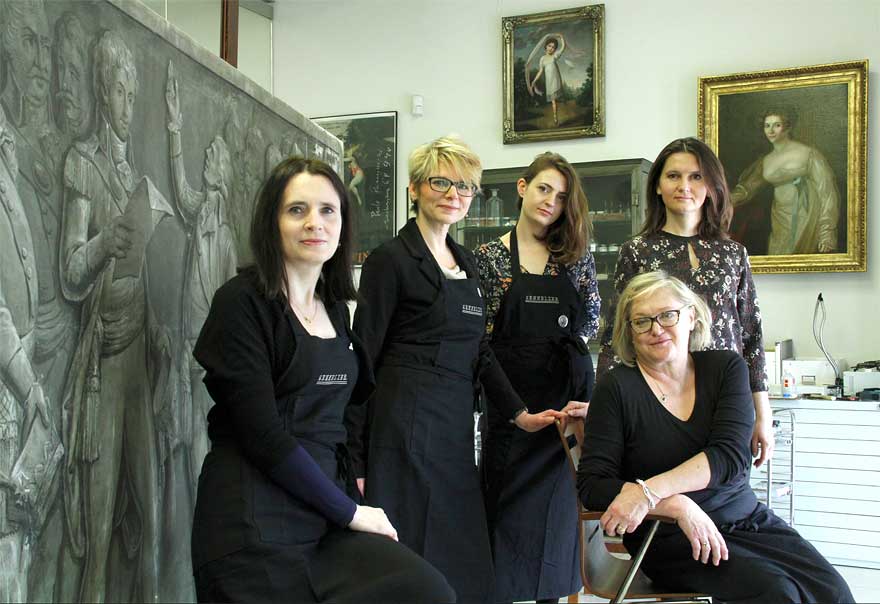
Studio team, the Cloth Hall, January 2014. From the right: E.Zygier, M.Tarnowska-Reszczyńsk, B.Urbańczyk, M.Sieklucka, G.Banach-Kielanowska, D.Sarkowicz.
The conservation and research work is conducted with the use of non-invasive and non-destructive physicochemical methods: photographs taken in analytical radiation environments (VIS, UV, IR, X-ray) and primer and pigment analyses using X-ray fluorescence spectroscopy. In their research projects the conservators work together with the National Museum’s Laboratory of Analysis and Nondestructive Investigation of Heritage Objects (LANBOZ). The projects focus on the work of artists active in the 19th century.
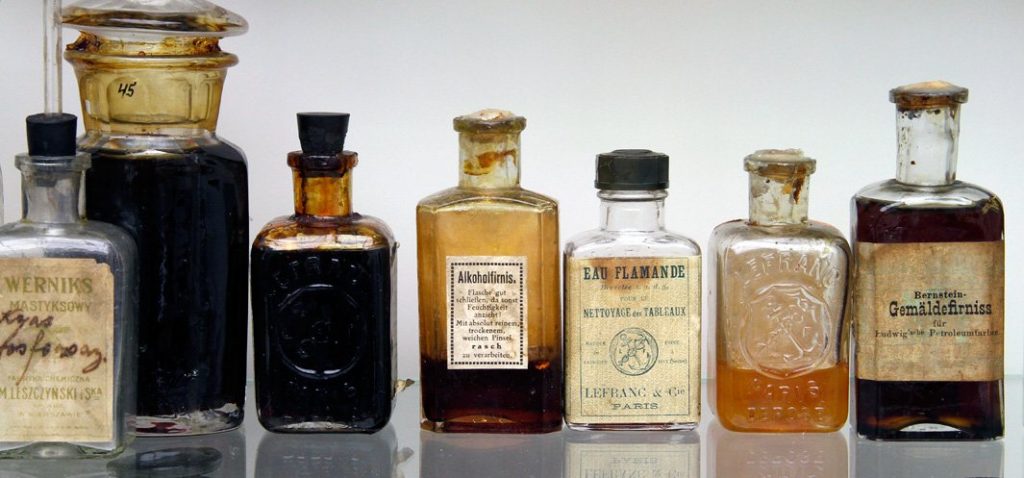
The studio has been linked to the Sukiennice almost since the foundation of the museum, although formally (i.e. with employment in full-time positions) has only been its part for a few decades. Its establishment concluded a period of efforts to secure professional care of the growing collection and inaugurated a new department, important for the preservation of the assembled artworks. Before the studio was formed (with a full-time conservator position), conservation procedures had been outsourced, mostly to active artists. Among these, a notable contribution was made by Władysław Pochwalski (1860–1924), who renovated oil paintings on both canvas and wooden supports. Many of the exhibits on display at the Gallery of 19th-century Polish Art in the Sukiennice still bear traces of that work, whether performed by Pochwalski himself or under his supervision. Its scope varied: from preventive preservation, to surface cleaning, to varnishing the layers of paint. The conservation work involved the use of commercial chemicals, whose manufacture developed rapidly from the 19th century onwards. Some of those historical chemicals have survived in their original packaging; they are kept with great care at the Sukiennice as a valuable subject of research.
In the years 1928–1935 the museum’s management commissioned conservation work to Mieczysław Gąsecki (1883–1948). An artist and valued renovator, he was also known in art circles for his friendship with Jacek Malczewski. As he had the museum’s complete confidence, the paintings were delivered to his private studio, although he also performed some work on site, at the Sukiennice gallery. He continued to collaborate with the National Museum in Krakow after the conservation studio was formally established.
The Painting and Sculpture Conservation Studio, with a full-time conservator position, was established in 1935. The first person employed in that position was Anna Skraszanka-Szuster (1908–1948), an art historian with a master’s degree in philosophy who also studied painting conservation at the Academy of Fine Arts in Krakow. Archive records indicate that she set up the first studio at the Szołayski House at 11 Szczepańska Street, but there is no doubt that the procedures recorded for that period with respect to two large paintings by Matejko, Kościuszko at Racławice and Wernyhora, were performed on site in the Sukiennice.
The outbreak of World War II determined the museum’s conservation activities for years to come. It became urgently necessary to evacuate and secure the collections, and then renovate damaged objects after the war.
In 1945 the studio’s most pressing task was the conservation of The Prussian Homage by Matejko. The procedures were performed at the Sukiennice, by the conservators employed there. Their work met with considerable public interest and was documented by the press (Arcydzieło Matejki wraca do świetności [Matejko’s masterpiece regains its glory], Przekrój 14, 15–21 July 1945).
From the 1960s, museum conservation gained recognition as an important discipline, which fuelled the further development of the studio. In 1961 Maria Niedzielska (1923–2012) set up a small chemical lab at the Sukiennice which was useful for on-site research.
In 2007–2010, with funding from the Norwegian Financial Mechanism, the Painting and Sculpture Conservation Studio at the Sukiennice was completely modernized and received specialist equipment for the research and conservation of art objects. Renovation work now involves the use of a low-pressure lining table, a binocular microscope, as well as photographic and lighting equipment for VIS photography, and computer hardware. The only remnant of the previous furnishings and equipment is the case in which the staff have assiduously preserved, for several decades, vintage pigments, varnishes, adhesives and other materials documenting the history of conservation at the museum.
Research projects of the Conservation Department involving conservators from the Painting and Sculpture Conservation Studio at the Sukiennice:
Gallery of 19th-century Polish Art in the Sukiennice
Rynek Główny 3
+ 48 12 433 54 40, + 48 12 433 54 11
e-mail: dksukiennice@mnk.pl