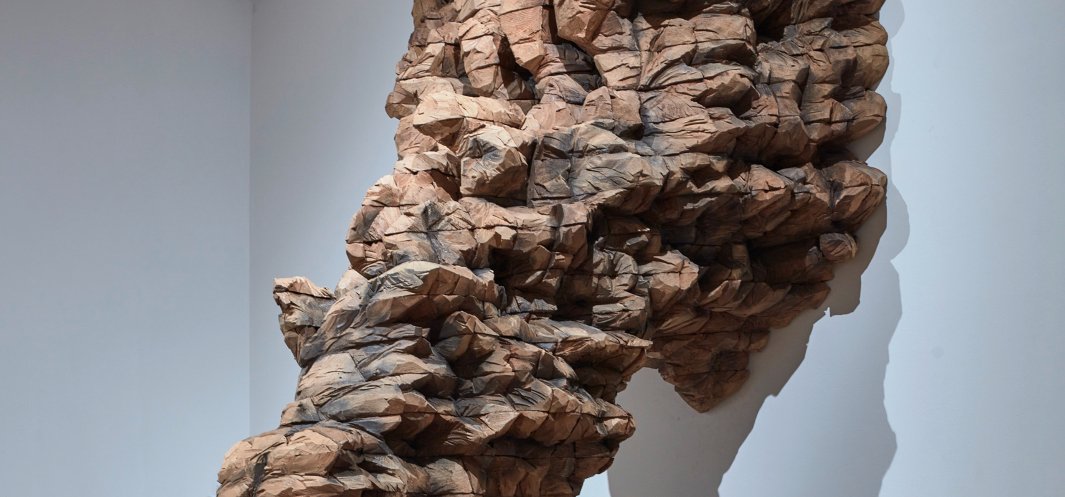
Ursula von Rydingsvard (b. 1942) is an artist of Polish origin who lives and works in New York. She creates monumental spatial compositions using modules of uniform dimensions: 4 x 4-inch sections, layered to form sculptures several metres high. The minute, rhythmic details contrast with the massiveness of the form. The primary material of her art is cedar wood: light, durable and strongly aromatic. The process of creating her works is painstaking and lengthy, giving it a distinctly meditative character. Ursula von Rydingsvard is characterised by a truly Benedictine work ethic.
The power conveyed by her sculptures stems from their close ties to nature and tradition, whilst remaining free from literal representation. They are poetic, multi-layered impressions, and their monumental scale inspires awe in the viewer.
Ursula von Rydingsvard’s sculptures defy the conventional definition of beauty – the sculptor herself claims she dislikes the word, as no one really knows what it means.
“MOCNY” is a suspended spatial composition whose irregular, twisted form evokes associations with the natural texture of old tree trunks. Mounted on the wall, the sculpture seems to soar violently into space. It exudes a raw energy stemming from its intense expression.
Whilst the work itself is unique within the MNK’s sculpture collection – our museum does not possess many examples of contemporary wooden sculpture on a monumental scale – the artist herself and her distinctive creative journey are equally significant. Ursula von Rydingsvard was born into a poor peasant family, and her childhood was marked by constant moves between refugee camps: the artist remembered the austere, wooden architecture of these places, and the memory of wood returned when she first visited Poland in 1985. Milada Ślizińska, curator of the first Polish exhibition of Ursula von Rydingsvard (CSW Zamek Ujazdowski, 1992), wrote the following about her non-obvious Polish heritage:
The fifth of seven children, born in Germany, raised in refugee camps, educated in the United States, she holds in her memory numerous words, associations, images and situations torn from their cultural context, originating in a country she never knew. Urszula’s practice of giving her works Polish titles (…) [is] the construction of what is known as ‘second-hand memory’.
An important part of von Rydingsvard’s identity is her experience of immigration – the fact that she initially felt like a stranger in the United States meant she was forced to try harder to prove her worth as an artist.
In 1980, she caught the attention of art critics with a massive composition in the open, sandy space of Battery Park City, ‘The Dream of Saint Martin’. This work blended organically into the natural terrain, much like her earlier works in the land art movement.
The artist’s works are held in numerous American collections, including those of the Museum of Modern Art (MoMA) in New York, the Albright-Knox Art Gallery, The Brooklyn Museum and the National Museum of Women in the Arts in Washington. The exhibition at Yorkshire Sculpture Park (1997) cemented Ursula von Rydingsvard’s international reputation.
Within the collection of 20th-century sculpture, Ursula von Rydingsvard’s work will engage in a dialogue with the works of other sculptors who have chosen wood as their medium – the most intriguing comparison seems to be that between the artist and the eminent Kraków-based artist Jerzy Bereś, not only because of the similarity in material, but also because for both artists the choice of wood has a deeply symbolic meaning and is linked to reminiscences of the culture of the mountainous regions of southern Poland (Bereś came from the Beskid Sądecki, whilst Ursula von Rydingsvard’s mother lived in Koszarawa in the Beskid Żywiecki).
The inclusion of Ursula von Rydingsvard’s works in our Museum’s collection highlights an important theme of the manifestation of Polishness by émigré artists, as well as Polish inspirations among international artists.
Compiled by: Agata Małodobry
Acquisition of the sculpture “MOCNY” by Ursula von Rydingsvärd.
Project funded by the Minister of Culture and National Heritage.
Total value of funding: 1,319,630 PLN
Funded by the Minister of Culture and National Heritage