Thanks to financial support from the Ministry of Culture and National Heritage, the MNK’s collection of contemporary art has been expanded with new acquisitions. As part of the project “Dialogue with Modernism: Contemporary Art in the Collection of the National Museum in Kraków”, in 2016 we acquired for our collection exceptional works that engage perfectly with the modernist tradition.
Barbara Falender, two outdoor sculptures
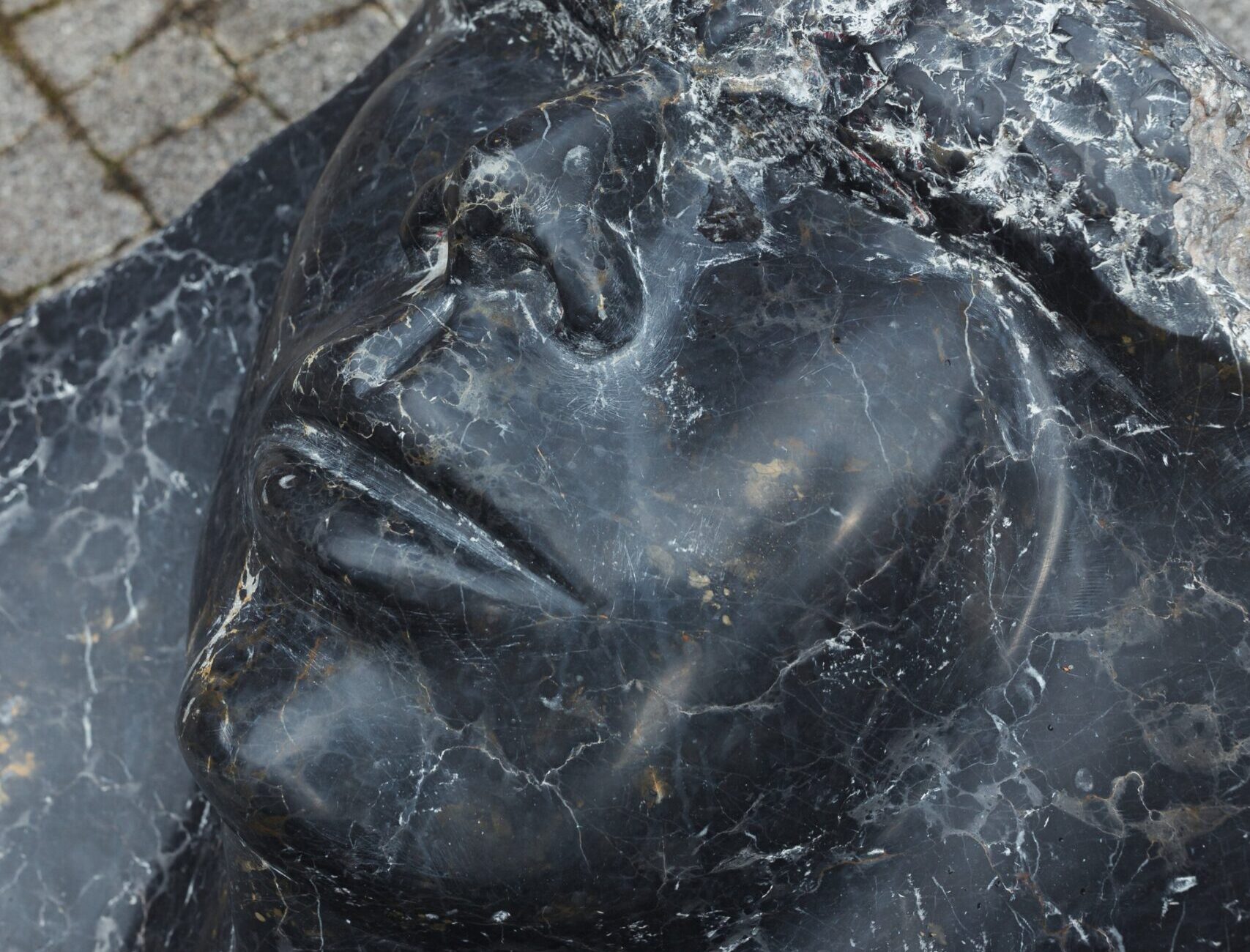
Sarcophagus (Sarcophagus for Mother), 1993, black marble (Dębnik, Poland), pink marble
(Śludanka, Bulgaria), 95 x 112 x 148
Sarcophagus for Parents, 2011, marble, steel, 200 x 405 x 154 cm;
The acquired works are characteristic of Barbara Falender’s entire oeuvre, forming part of a body of work on similar themes that she has created in recent decades, addressing identity, memory, the body and female sexuality. The artist is distinguished by her superb craftsmanship, her feel for a material as challenging as marble, her consistent yet creative development of her own sculptural vision, and her unique interplay with traditional sculptural materials.
‘Sarcophagus for Parents’, due to its weight and massiveness, tends to lean downwards; however, by suspending this work in space, the artist lends it an unexpected lightness. The human figures depicted, nestled together in a hammock in a position of complete calm and relaxation, seem to be lulled to sleep by a ‘gentle rocking’. At the same time, a certain drama can be discerned in the depiction. The sculpture is dedicated to the artist’s parents, who have passed away. Referencing the monumental sarcophagi known from art history, Falender speaks of the private sphere, expressing the delicate, unique relationship that bound her to her mother and father. Despite its large size, unlike traditional monumental works, the sarcophagus of Falender’s parents is an extremely intimate piece. In doing so, the artist challenges existing conventions of representation. She utilises them freely and alters them in an attempt to present her own private story.
The same applies to the second ‘Sarcophagus’, where the cubic form, made of black marble typically used for gravestones, is contrasted with a sculpture of a fragment of a woman’s body, crafted from pink marble. It can be viewed as a monumentalisation of an intimate reflection on transience and the decay of the body.
The acquisition of these two large-scale sculptures for the Museum’s collection has allowed for the expansion of the modest collection of works by Barbara Falender, previously represented in the National Museum in Kraków’s collection solely by the 1978 work *Odpływ*.
Andrzej Pawłowski, Hipogryf from the “Heliograms” series, 1956
Pawłowski’s heliographs are unique objects. They are phototypes in which the image is the result of projecting artificial or natural light onto light-sensitive paper through flat or three-dimensional, semi-transparent paper models with geometric shapes. The acquired work Hippogriff from the ‘Heliograms’ series is an example of the artist’s early experiments with this technique and perfectly illustrates his concept of the Naturally Shaped Form. In this theory, the role of chance is significant; this has particularly interested artists since the first Surrealist works, which emerged from the theory of automatic writing. In Pawłowski’s concept, the experiences of Dadaism—with its emphasis on the role of the absurd—and Surrealism—with its metaphysical meaning of existence—are layered upon one another.
The Hippogriff is a heliograph, and no authorised exhibition replica of this work in the form of a photograph exists. (In 1978, Andrzej Pawłowski produced such replicas in larger formats than the heliographs for several works from the ‘Heliograms’ series).
The work complements the modest collection of Andrzej Pawłowski’s works in the National Museum in Kraków (2 paintings and 6 sculptures), 5 of which are on permanent display in the 20th-Century Painting Gallery. The opportunity to display this artist’s heliographs will enrich the presentation of the Second Kraków Group—a phenomenon of that period that stands out against the backdrop of Polish Socialist Realism—with a unique example from the field of photography.
Andrzej Ziębliński, Frame A7980 5050, 1978–1983
The painting Kadr A7980 5050 is an important element of Andrzej Ziębliński’s prolific oeuvre. The point of reference for the painting’s intricate composition is geometry, the language of which the artist uses to develop a surrealist reflection on the representation of reality on canvas. In it, the artist refers to the concept of the ‘golden mean’ and convergent perspective. These are means of ‘expanding’ the internal space of the painting to infinity. Kadr A7980 5050 is divided into nine abstract spaces that engage in a visual dialogue with one another. It should be viewed through 3D glasses. This original way of viewing the painting provokes reflection on the various ways of looking at works of art proposed over the years by the modernist tradition. Until now, the MNK collection contained only one painting by Andrzej Ziębliński. Three other works by this artist are on loan.
Piotr (Peter) Grzybowski, Untitled/Painting 3 from the series ‘Paintings’
The art of Piotr Grzybowski, one of the most important Polish performers of the Kraków neo-avant-garde of the 1980s, is part of artistic practice involving the documentation of performance.
The painting entitled ‘Painting 3’ refers to performance actions in which the direct experience of the event is paramount. It belongs to the artist’s graduation series at the Academy of Fine Arts in Kraków. It was created on the basis of photographic documentation of actions performed in Kraków during martial law in a private flat. Modelled on colour photography, it is formally interesting. One can discern in it streaks of light and indefinite shapes that the “camera’s eye” failed to capture in the darkness. Peter Grzybowski’s work stands out against the backdrop of documentation of ephemeral art, which is usually recorded using photography or video. It complements the performance documentation in the collection of the National Museum in Kraków, which comprises works by Zbigniew Warpechowski, Julian Jończyk and Adam Rzepecki. It serves as a vital link between modernist art, based on the object of the painting, and ephemeral art, arising from the experiences of conceptualism—which transcends modernism—and expressed through performance art. Due to his exceptionally interesting body of work, the artist is increasingly being recognised by art historians. The purchased painting is the first work by Piotr Grzybowski in the National Museum in Krakow’s collection.