 MNK Main Building
Since the opening of the exhibition of modern and contemporary art in the MNK Main Building (1959), the National Museum in Kraków has been consistently building its collection of contemporary art, focusing on the most interesting developments in the field and selecting works by artists who are distinctive representatives of their era. We are, however, aware that art from the first decades of the 21st century remains under-represented in major national art collections. These are years of revisiting modernism, new interpretations of cultural phenomena from the People’s Republic of Poland, and a fresh perspective on themes previously marginalised or rejected by high culture; moreover, this is a time of distance from the political events that led to the collapse of the communist system in Poland and Europe.
By constantly updating our collection, thanks to a grant from the Ministry of Culture and National Heritage, we have expanded it to include works by artists whose creations are a significant voice in the discourse on generational change: Monika Sosnowska’s sculptural installation Schody and Piotr Uklański’s photographic diptych Solidarność. Both are part of the canon of contemporary Polish art and are already recognised beyond our country’s borders.
In their work, both draw on Polish history – Monika Sosnowska creatively interprets the history of 20th-century architecture, whilst Uklański examines political history, also referencing the art of bygone eras, capturing and deconstructing trivialised cultural codes.
Monika Sosnowska (b. 1972) graduated in painting from the University of Arts (then the Academy of Fine Arts) in Poznań and completed postgraduate studies at the Rijksakademie van Beeldende Kunsten in Amsterdam. In 2003, she took part in the main exhibition of the Venice Art Biennale (curated by Francesco Bonami); in the same year, she was awarded the Bâloise Prize at Art Basel. In 2007, she represented Poland at the 52nd Venice Biennale; her site-specific installation 1:1 was exhibited in the Polish pavilion at that time. Sosnowska has exhibited at venues including MoMA in New York, and was awarded the Polityka Passport and a scholarship from the Schering Foundation at Künstlerhaus Bethanien in Berlin.
The starting point for Monika Sosnowska’s works is modernist architecture (primarily from the communist era, though occasionally from the classical modernism of the interwar years), which is the subject of her sculptural transformations and deformations.
She is interested in the details of buildings and building materials: concrete, steel structures, and reinforcement. In her works, she reflects on the durability of architectural objects, modifying and transforming their details. Through her practice, she transforms physical spaces into mental spaces, encouraging viewers to reflect on the non-functional aspects of architecture.
In Sosnowska’s interpretation, modernism is not a ‘dead language’ – it is creatively transformed, becoming a basis for reflection on the legacy of the 20th century. Architecture loses its functionality, plays with the viewer’s perception, and becomes a source of tension. The artist critiques the utopian visions of communist-era modernisation by depicting architecture in a state of decay, decay and disintegration.
It is modernism, but in a state of collapse. Sosnowska challenges the modernist pursuit of perfection and pure aesthetics.
“It seems to me that what I do is somewhat in opposition to what architecture is,” explained the artist during the presentation of her 1:1 project in 2007 at the Venice Art Biennale – I also think that my art is a completely different discipline, even though I focus on the same issue as architecture: the shaping of space. The fundamental characteristic of architecture is its utilitarianism. Architecture organises, brings order, and reflects political and social systems. My works, on the other hand, introduce chaos and uncertainty”. A dozen or so models of Monika Sosnowska’s sculptures from 2002–2020 are currently on display at the exhibition Transformations. Modernity in the Third Republic of Poland in the MNK Main Building of the National Museum in Kraków.
Monika Sosnowska, Stairs, 2016
110 x 150 x 1200 cm
Painted steel
Stairs is a large-scale steel installation. The flight of stairs depicted is uneven, full of kinks and deformations. They cease to be a means of access within the building, becoming instead a gigantic obstacle, a mysterious labyrinth that arouses unease rather than inviting entry. This impression is further heightened by the installation’s uniform, deep black colour. The enormous piece of metal appears to have been hurled with great force from a ruined building, suggesting post-apocalyptic interpretations. The Stairs direct our thoughts to neglected buildings from the communist era, whose current state of disrepair contradicts their architects’ visions of durable construction and timeless style. Were the communist-era visions of modernisation a utopia? Should we protect buildings from decades past, restoring them to their original condition? What will happen if we forget our heritage? Monika Sosnowska’s installation inspires such reflections, among others. In the work Stairs, beyond the intellectual concept of a dialogue with the socialist-modernist past, the subtle beauty of the entire structure is also significant – its shifting rhythms and minimalist repetition.
Piotr Uklański (b. 1968) studied painting at the Academy of Fine Arts in Warsaw and photography at Cooper Union in New York. His works are held in leading museum collections worldwide, including MoMA, the Whitney Museum and the Guggenheim Museum in New York, Tate Britain and Kunsthalle Basel. He is also a film director, having made the feature film Summer Love (2006). Uklański has lived in New York for many years, but in his work he continues to reference his Polish heritage in various ways. His work is characterised by eclecticism – the artist employs the full spectrum of media and techniques – yet it consistently features a playful engagement with the past, reflections on history (both the ‘grand’ history influencing geopolitics and the ‘invisible’ history of everyday life), and the art of bygone eras. His art contains references to Polish national myths and stereotypes, to popular culture and the works of other artists.
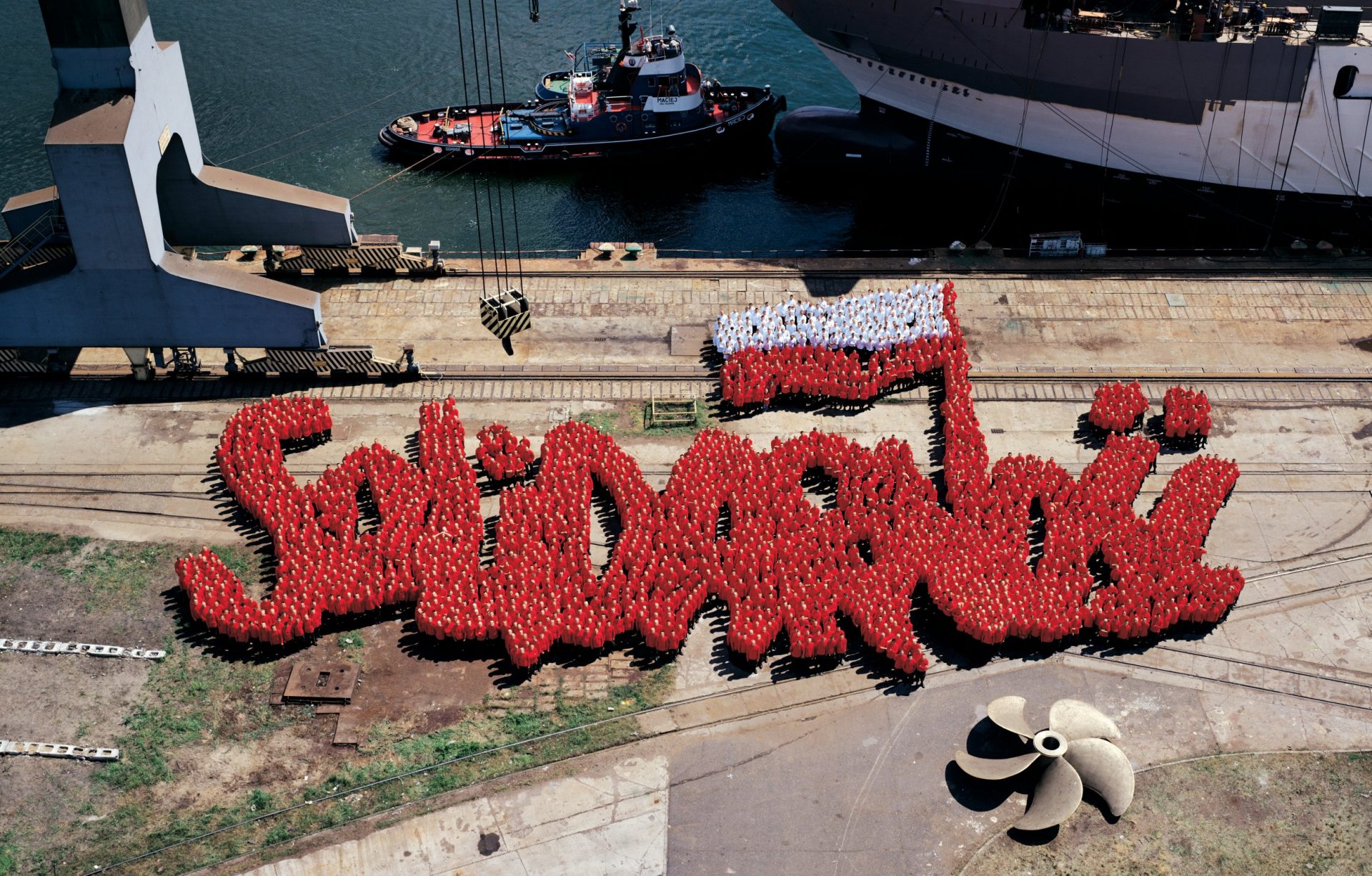
Piotr Uklański, Untitled (Solidarity), 2007
2 colour photographs on Dibond, wooden frame, 155 x 235 x 5 cm and 155 x 235 x 5 cm
The diptych Solidarity consists of photographs taken by Piotr Uklański at the Gdańsk Shipyard – the very place where, in 1980, Solidarity was founded as a result of workers’ strikes. This trade union became a mass, nationwide social movement in opposition to the authorities of the People’s Republic of Poland. Uklański spectacularly reworked the famous Solidarity logo, designed by Jerzy Janiszewski. From a group of around 3,000 extras – soldiers in red and white uniforms – he arranged the word ‘Solidarity’ alongside a red-and-white flag and photographed it from a considerable height, framing the shipyard buildings within the shot. The first photograph faithfully reproduces the Solidarity logo, whilst in the second the soldiers are dispersing, rendering the inscription illegible. As Andrzej Szczerski writes about this work, it indicates that “[…] collective actions may be enforced and serve propaganda purposes, but they may also result from the individual decisions of specific people, as in the case of ‘Solidarity’.” The photographs represented those who are able to unite in order to achieve a goal that is important to them. At the same time, referring to the realities of the transition period, they demonstrated that such a voluntary community is not guaranteed once and for all and may cease to exist at any moment, with collective action being replaced by individualism” (exhibition catalogue Transformation. Modernity in the Third Republic of Poland, 2024). The way in which Uklański photographed a crowd of anonymous individuals forming part of a ‘living picture’ draws on the propaganda photographs, known as living photographs, commissioned by the US Army between 1915 and 1920 by Arthur Mole and his assistant John Thomas, in which people are merely a mass: a tool for constructing a striking image.
The tradition of these staged shots was adopted by communist countries (such images were arranged during parades and national holidays), and it continues in the world of sport. Uklański himself first used this method in 2004 in his work Untitled (Ioannes Paulus PP. II Karol Wojtyła) – a work now in the collection of the National Museum in Warsaw) he arranged the face of Pope John Paul II with the help of a group of 3,500 Brazilian soldiers: half-naked men formed the skin of the face, whilst a larger group dressed in white ‘portrayed’ the hair, the skullcap and a section of the cassock.
The diptych “Solidarity” is an original, signed print of a photograph by Piotr Uklański from 2007, prepared specifically for the National Museum in Kraków.
Agata Małodobry
The funding value of the project is PLN 500,000, the total project value is PLN 514,000.
Targeted grant from the funds of the Minister of Culture and National Heritage, drawn from the Culture Promotion Fund – a state-funded special-purpose fund
Project title: Expansion of the MNK’s contemporary art collection – purchase of the sculpture ‘Stairs’ by Monika Sosnowska and the diptych ‘Solidarity’ by Piotr Uklański
Grant agreement signed in July 2025.