20–21 March 2025
National Museum in Kraków
20 March
MNK Main Building, Samurai Hall
8:30–9:00 Registration
9:00–9:15 Opening of the conference
9:15–9:45 Prof. Svitlana Rybalko (Kharkiv State Academy of Culture) – Dialogues with Kitagawa Utamaro
Panel I: Around Utamaro
9:45–10:15 Beata Romanowicz (National Museum in Krakow) – Utamaro – not just women
10:15–10:45 Agnieszka Gach (National Museum in Kraków, Jagiellonian University) – The hidden language of symbols. Japanese fashion and design reflected in woodblock prints and textiles
10:45–11:30 Anna Bielak (Polish Kimono Association “Kimonobeya”) – The kimono as a form of expression. Since the time of Utamaro…
11:30–11:45 Coffee break
11:45–13:15 Curator’s guided tour of the exhibition “Utamaro. Japanese woodblock prints from the collection of the National Museum in Kraków”
13:15–13:30 Organisational break
Panel II: Theatre and literature
13:30–14:00 Prof. Estera Żeromska (Adam Mickiewicz University
in Poznań) – Utamaro on theatrical paths
14:00–14:30 Anna Sekikawa (independent researcher) – Koharu and Jihei. The fate of the lovers from Amijima against the backdrop of the era in which Chikamatsu
and Utamaro
14:30–14:45 Coffee break
Panel III: Tradition combined with modernity
14:45–15:15 Dominika Fiut (Jagiellonian University) – Traditional Japanese storytelling – rakugo, a bridge to Edo
15:15–15:45 Magdalena Święch (National Museum in Kraków) – Classic motifs from Kitagawa Utamaro’s woodblock prints
in nineteenth-century Japanese photographs
15:45–16:15 Interview with Prof. Estera Żeromska on the book “Modern Japanese Theatre. From kabuki to shinpa, or the troubles of realism”, conducted by Prof. Tadeusz Kornas (Jagiellonian University)
17:00 Dinner for speakers
21 March
MNK Main Building, Samurai Hall
Panel IV: Culture and Tradition
9:00–9:30 Dr Ewa Kamińska (Jagiellonian University) – Decoding symbols of feminine beauty based on woodblock prints from the Edo period (1603–1868)
9.30–10.00 Dr Gabriela Matusiak (Jagiellonian University) – (Un)usual moments of intimacy in selected illustrations from the album
Komachi-biki by Utamaro
10:00–10:45 Joanna Haba (Ikenobō School, Manggha Museum of Japanese Art and Technology) – The spirit of flower arranging – ikebana of the Ikenobō School
10:45–11:30 Anna Jodłowska, Beata Kapanowska (Polish Kimono Association “Kimonobeya”) – …to this day. The kimono as a form of expression
11:30–12:00 Coffee break
Panel V: Conservation
12:00–12:30 Anna Tabisz (National Museum in Kraków) – The simple life of extraordinary objects. How we brought out the beauty of Japanese clothing
12:30–13:00 Dr Julio M. del Hoyo-Meléndez, Ewa Sobiczewska (National Museum in Kraków) – Identification of materials and techniques used in Kitagawa Utamaro’s Japanese woodblock prints – research and its significance for conservation
13:00–13:30 Katarzyna Skowron, Dominik Dziadusz (National Museum
in Kraków) – Accessible heritage – the use of electroplating in the creation of replicas of museum artefacts
13:30–13:45 Arleta Chwalik-Sadaić (National Museum in Kraków) – Aesthetics or tradition? Challenges associated with the conservation of objects decorated with Japanese lacquer, illustrated by conservation work carried out on a Japanese tengu mask from the collections of the National Museum in Kraków
13:45–14:15 Coffee break
Concert
14:15–15:00 Katarzyna Karpowicz, concert of traditional Japanese music
on the koto
Panel I
Around Utamaro
Beata Romanowicz, National Museum in Kraków
Utamaro – not just women
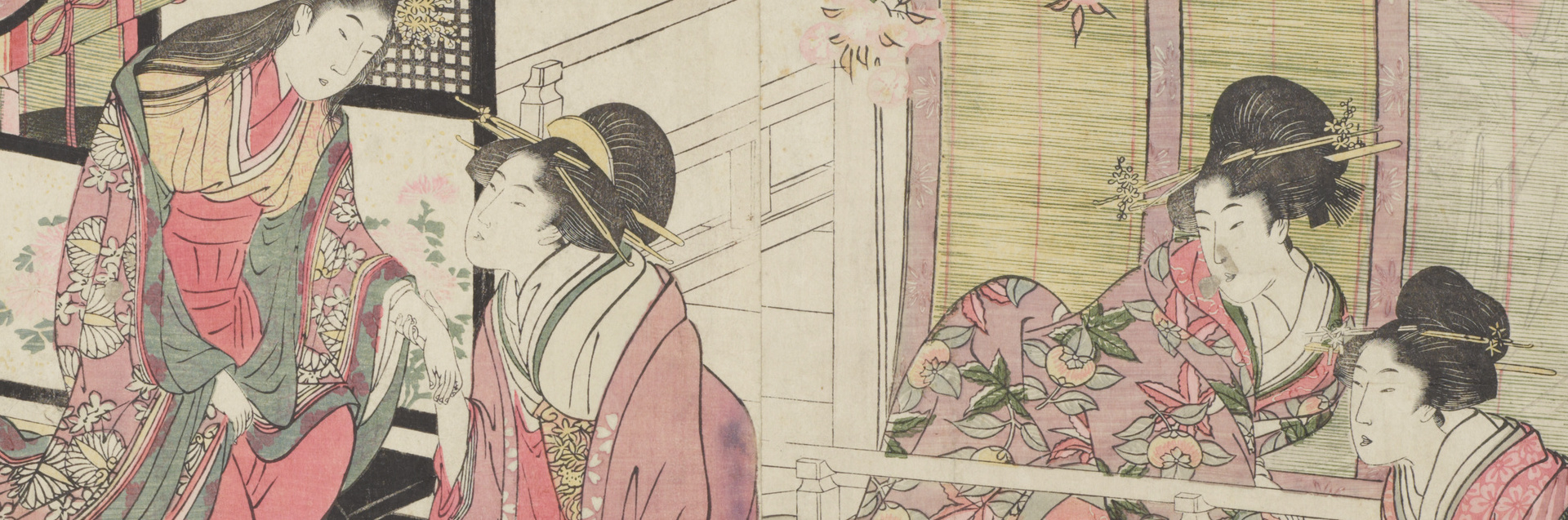
Kitagawa Utamaro is regarded as an expert and painterly champion of feminine beauty. However, the exhibition at the National Museum in Kraków, as well as this presentation, address Utamaro’s artistic sensibility, highlighting a much broader spectrum of his perception of the world than merely the category of bijinga – portraits of beautiful women.
We also highlight the theme of children and the world around them, their relationships with parents, and the tenderness of fathers. The physiognomist’s observation allows for descriptions of characters’ personalities, for example in love stories and erotic images. There is room in his work for humour and for treating the gods of happiness as companions in quite human revelries. Insight and excellent observation of nature translate into images of plants, small and large animals, and insects. There is also a narrative of warriors from the musha-e category and ‘painting with the wind’, that is, landscape views.
Thematic categories organise Japanese art, and in particular the discussion of ukiyo-e woodblock prints (pictures of the Floating World); yet in Utamaro’s work we experience the interplay of these themes, sensibilities and visions.
Agnieszka Gach, National Museum in Kraków, Jagiellonian University
The hidden language of symbols. Japanese fashion and design reflected in woodblock prints and textiles
Japanese ukiyo-e woodblock prints illustrate the complex diversity of Japanese culture during the Edo period (1603–1868), when the tastes of the era were largely determined by members of the bourgeoisie. In their day, these works were the equivalent of magazines or advertisements. They facilitated the dissemination of information about the latest fashion trends, offering inspiration to those who wished to emulate the stylish men and women depicted in them. Today, they constitute a rich source of information on the history of Japanese fashion and the decorative motifs popular at the time.
The talk will focus on discussing the motifs adorning the garments of the female subjects in Kitagawa Utamaro’s woodblock prints. An analysis of the traditional Japanese textiles presented in the exhibition space “Utamaro. Japanese Woodblock Prints from the Collection of the National Museum in Krakow” will also aid in interpreting their cultural and symbolic significance.
Anna Bielak, Polish Kimono Association ‘Kimonobeya’
The kimono as a form of expression. Since the time of Utamaro…”
During the Edo period, Japanese attire had two faces. On the one hand, it was an element of everyday life and a sign of social status, strictly subject to rules imposed by the government. On the other hand, it proved an excellent pretext for circumventing the rules and drawing on unconventional sources of inspiration. This duality not only laid the foundations for the development of the modern kimono, but also opened a new chapter in its history, in which the kimono flourished as a widely accessible form of expression.
Panel II
Theatre and Literature
Anna Sekikawa, independent researcher
Koharu and Jihei. The fate of the Amijima lovers against the backdrop of the era in which Chikamatsu and Utamaro created
During the Genroku period (1688–1703), entertainment districts became an escape for townspeople from the daily struggles and family and social obligations. Marriages were not based on feelings or free choice, and patient, obedient wives were not attractive conversational partners, which led men to seek happiness in the ‘floating world’.
The growing influence of Confucian ethics at that time demanded the fulfilment of family duties, loyalty and harmony. It was combined with Buddhist teachings, which preached the necessity of suppressing feelings, submission and the expectation of reward in the next incarnation.
The entertainment districts offered a respite from the dictates and norms of the outside world, yet the seemingly joyful atmosphere there was accompanied by sadness, as the women who looked after the customers’ happiness were usually slaves, sold by parents who lacked money. The cruelty and injustice of the world were reflected in the dramas of that period.
Chikamatsu Monzaemon describes in his works the stories of despairing lovers who choose suicide rather than a life apart. Examples of such characters are Koharu and Jihei, whose fates are depicted in the bunraku play ‘Shinjû ten no amijima’.
Here, the author clearly depicted the complexity of human emotions and the psychological underpinnings of their actions, drawing attention to the inner workings of the human mind and the classic conflict between emotion and duty, whilst simultaneously seeking to emphasise the immense value of human life.
The characters of Koharu and Jihei also served as inspiration for Utamaro, who immortalised a key fragment of their love story in his woodblock print.
Panel III
Tradition combined with modernity
Dominika Fiut, Jagiellonian University
Traditional Japanese storytelling – rakugo, a bridge to the Edo period
Rakugo, or traditional solo storytelling, is a stage form with its origins in Buddhist sermons from the 16th and 17th centuries, which took on its contemporary character during the Edo period. A lone artist, using facial expressions, voice and subtle gestures, presents the audience with a story about the lives of the Japanese people, commenting on their foibles in a humorous manner. Rakugo has survived through the centuries thanks to its adaptability, adjusting to new forms of communication whilst remaining faithful to its most important traditions and classic structures. The canon of rakugo comprises over a hundred stories set in the everyday reality of the middle classes – it was within this milieu that this art form developed.
The talk will address the key issues in the history of rakugo and highlight its connections with the Edo period, demonstrating rakugo’s potential as a bridge between the present and the history of Japanese society.
Magdalena Święch, National Museum in Kraków
Classic motifs from Kitagawa Utamaro’s woodblock prints in nineteenth-century Japanese photographs
The first camera arrived in Japan in the 1840s. The significant development of photography, however, took place in the 1860s, a time when Japan was undergoing profound reforms and modernisation processes linked to the end of isolationism and its opening up to the world. However, the photographic images of that era conceal from the viewer the changes taking place in the Japanese landscape and the daily lives of its inhabitants. They depict, to a large extent, a country deeply immersed in the pre-modern era, inhabited by a society living
in harmony with nature and close to it.
Panel IV
Culture and tradition
Dr Ewa Kamińska, Jagiellonian University
Decoding symbols of feminine beauty based on woodblock prints from the Edo period (1603–1868)
The Edo period in Japanese history was a time of profound social
and cultural transformation, the most significant of which was the flourishing of cities and bourgeois culture. Daily life stabilised and the bourgeoisie grew wealthy, enabling them to enjoy luxury items previously reserved for the court aristocracy and samurai. The financial power of the bourgeoisie, mainly merchants and craftsmen, led to a radical change in the image of women belonging to this class. Often, their outward appearance was similar to that of women from the upper classes, or even surpassed it in terms of the quality of fabrics
and accessories.
Was there, therefore, a single prevailing ideal of beauty? As the differences in women’s outward appearance faded, did elements emerge that indicated membership of a particular social group? What determined one’s elegance? We shall attempt to find answers to these questions by analysing the images of women depicted in ukiyo-e woodblock prints.
Dr Gabriela Matusiak, Jagiellonian University
(Un)ordinary moments of intimacy in selected illustrations from the album Komachi-biki by Utamaro
Like many ukiyo-e artists, Utamaro created not only sophisticated illustrations of beautiful women, but also album series of woodblock prints on erotic themes – shunga – including: Utamakura (1788), Negai no Itoguchi (1799) and Komachi-biki (1802). Each of these delighted with their artistry and exceptional attention to detail. Despite this, the last of the albums mentioned has not, to this day, enjoyed a popularity comparable to Utamaro’s earlier erotic publications.
Presumably, one of the reasons is that, despite the craftsmanship characteristic of the work, the depicted sex scenes are not as shocking, or perhaps not sufficiently intriguing, as, for example, the illustrations from the Utamakura album, which include erotic scenes featuring kappas, foreigners or a rape scene.
In her presentation, the author will present and discuss selected illustrations from the Komachi-biki album, whilst highlighting the details of individual scenes, focusing on those elements which, within seemingly conventional depictions of couples in the act of sex, reveal the extraordinary beauty of intimacy captured by a skilled artist.
Joanna Haba, Ikenobō School, Manggha Museum of Japanese Art and Technology
The spirit of flower arranging – ikebana of the Ikenobō School
All over the world, people love beautiful flowers, arranging them for various occasions in their daily lives. Just like poems, floral arrangements can be formal or informal, joyful or sad, spontaneous or solemn. Celebrating special events or expressing emotions through flowers is part of human nature and a custom shared by many civilisations and cultures. However, there is a distinctive feature of Japanese culture in this regard. It is a subtly developed aesthetic sensibility born of the beauty of the Japanese natural environment – an archipelago of islands stretching across the vast Pacific Ocean. It is an awareness that beauty lies not only in flowers in full bloom, but also in leaves, branches and grasses.
This is how the Japanese art of flower arranging, ikebana, came into being – from the words: ikeru (Jap. to give life) and hana (Jap. flower), which literally means ‘living flowers’.
It is a tradition that dates back over 550 years, originating from Buddhism. Beyond the floristic practice itself, ikebana is a form of meditation, spiritual development and a philosophy of life. Practitioners of this art arrange flowers based
on a variety of plants, assessing their stage of development, angle of inclination and the ratio of length to the height of the vase used. A proper understanding of the natural order determines what will be expressed in the ikebana.
In my talk, I will introduce you to the tradition of the oldest ikebana school in Japan – Ikenobō, the so-called Founding Lineage of the Way of Flowers.
Anna Jodłowska, Beata Kapanowska, Polish Kimono Association ‘Kimonobeya’
…to this day. The kimono as a form of expression
Nowadays, the kimono accompanies the Japanese ceremonially
at the most important moments of life, but above all it is “something to wear” and, as an outfit, it is subject to trends and fashion. In the modern approach, kimono wearers have the option to disregard some of the kitsuke rules and allow themselves more casual styling. Second-hand kimonos have made a comeback, and Western elements of clothing and new inspirations can be seen in styling. Tradition blends with modernity to create a new face of the kimono.
Panel V
Conservation
Dr Julio M. del Hoyo-Meléndez, Ewa Sobiczewska, National Museum in Kraków
Identification of materials and production techniques in Kitagawa Utamaro’s Japanese woodblock prints – scientific research and its significance for conservation
Research into Kitagawa Utamaro’s Japanese woodblock prints focused on analysing the production techniques of the paper and inks, which served as the medium for the realisation of the artist’s final concept. The aim of the research was to determine the types of paper used, as well as to identify the traditionally used pigments and dyes in the original works created during the artist’s lifetime, and to compare them with copies produced during the Meiji, Taishō and Shōwa periods. Advanced research techniques were employed for the analysis, such as Fourier transform infrared spectroscopy (FTIR), X-ray fluorescence spectrometry (XRF), hyperspectral imaging, micro-EDX and Raman spectroscopy. These methods enabled the identification of chemical compounds present in the paper itself, as well as the organic pigments and dyes present in the print layers. The data obtained allow for a deeper understanding of the characteristics and chronology of the materials used in the production of coloured Japanese woodblock prints. The research conducted is of great importance for decision-making regarding the display, conservation
and protection of this type of artwork.
Katarzyna Skowron, Dominik Dziadusz, National Museum in Kraków
Accessible artefacts – the use of electroplating in creating replicas of museum artefacts
The accessibility of exhibitions is one of the most challenging issues in the field of museum accessibility. It is not only a matter of aesthetics and functionality, but also the safety of the artefacts. Every exhibition is different; it presents us with a different set of artworks, which we can make accessible in various ways. When a heritage object cannot be touched, we must devise another way of bringing it closer to those who can only experience it through touch.
This is how the idea of creating replicas of metal artefacts at the Metal and Weapons Conservation Workshop of the National Museum in Kraków came about.
In line with the actual budgetary constraints, the idea of producing traditional castings was abandoned. Instead, a galvanisation process was used, which exploits the electrochemical phenomena accompanying the flow of current between electrodes placed in a galvanic bath – in other words, the electrochemical coating of metal or other surfaces with metal.
The central theme will be how to resolve the problem by combining the experience of metal conservators, their technological knowledge, creativity and realistic budgetary constraints.
Arleta Chwalik-Sadaić, National Museum in Kraków
Aesthetics or tradition? Challenges associated with the conservation of objects decorated with Japanese lacquer, illustrated by the conservation work carried out on a Japanese tengu mask from the collection of the National Museum in Kraków.
Japanese lacquer is a highly sensitive material that degrades easily. This process is visible on the decorated surface, which becomes dull and loses its colour intensity. These changes directly affect the appearance and reception of the exhibited work.
Several objects featuring this type of decoration were presented at the exhibition “Utamaro. Japanese Woodblock Prints from the Collection of the National Museum in Kraków”, several objects featuring this type of decoration were presented. As part of the presentation, the challenges associated with the conservation and preservation of one of the exhibited works – a Japanese tengu mask – will be discussed. The issue will be examined through the prism of ethical and aesthetic differences between the European and Japanese schools of conservation.
Concert
Katarzyna Karpowicz
Concert of traditional Japanese music on the koto
The presentation will consist of a brief introduction to the history of the koto, the different types of the instrument, and how its status within Japanese culture has evolved. The structure of the instrument, playing techniques, repertoire, changes brought about by the Edo period, and innovations initiated by the most important composers at the turn of the 19th and 20th centuries will be discussed. The second part of the lecture will feature a presentation of Japanese music performed on the koto, ranging from older, classical pieces, through compositions from the early 20th century, to the contemporary repertoire.