The MNK Czartoryski Museum Book Collection forms the core of the library’s holdings. The collection currently comprises over 231,000 volumes, consisting of: early printed books (including incunabula and curiosities), modern prints (including ephemera and music prints), periodicals, maps and calendars. Many of these are bibliophile editions, unique items and extremely rare prints, featuring valuable bindings.
Among the 333 incunabula, the collection of Seville prints by Stanisław Polak (14 volumes) and the works of the itinerant Bavarian printer Kasper Straube, who worked in Kraków, are particularly valuable. The incunabula represented in the library are mostly religious, theological, liturgical, legal and philosophical prints, as well as historical and geographical ones. Some of them feature hand-painted multicoloured decorations, which adds to their value.
The Cimelia collection comprises 2,600 16th-century works on Polish subjects. This collection includes prints published in territories historically belonging to Poland and those relating to Poland. Among the treasures of the collection are Nicolaus Copernicus’s work: De revolutionibus… in a binding from the library of King Sigismund Augustus, the works of Maciej Miechowita and Marcin Kromer, which were the first lectures on the history of Poland, the Statutes of Jan Łaski, which can be regarded as the first constitution, and the works of Stanisław Orzechowski and Andrzej Frycz Modrzewski, which provide an interpretation of Renaissance society. Among the 16th-century Polish works are many unique items and copies of great artistic value.
In the collection of maps and atlases, the atlas factice by Antonio Lafreri, the hand-coloured map of Ukraine by Guillaume Beauplan, and the map of China from 1605 deserve special mention. An important part of the collection consists of city plans and views, as well as fortification and battle plans.
Among the 5,660 calendar yearbooks, the most valuable include 18th-century political almanacs, such as Kolęda warszawska and Kalendarz polityczny dla Królestwa Polskiego i Wielkiego Księstwa Litewskiego.
A collection of ephemera, organised by subject, provides important information on emigration issues and the Polish cause between 1800 and 1918. Listed in a separate catalogue, alongside items accessible only via the alphabetical catalogue, they comprise approximately 20,000 items.
Also of great value is the collection of periodicals, numbering around 3,800 titles, comprising Polish and foreign periodicals published from the 17th century to the present day. The oldest item is the ‘Gazette de France’ from 1635–1684, a collection of French newspapers bound together in a single volume at the beginning of the 19th century. Periodicals from the 18th and 19th centuries are well represented, including French, German, English and Polish titles. Among the Polish press of the 18th century, it is worth mentioning, among others, “Gazety Polskie”, “Monitor” and “Zabawy Przyjemne i Pożyteczne”. Of particular significance to the collection is the collection of periodicals and domestic and émigré newspapers from the 19th century. Noteworthy is, for example, the complete run of the Kraków daily “Czas”, published between 1848 and 1939, which is available in digital form on the Małopolska Digital Library website.
The music collection (printed works and manuscripts), gathered over several centuries by music enthusiasts, primarily the MNK Czartoryski Museum, forms a collection of great diversity. It encompasses all genres and forms of secular and religious music, both Polish and foreign, from the 13th to the 20th century. The collection’s main focus is on 19th-century European salon piano music.
The MNK Czartoryski Museum book collection is systematically expanded; this applies to serial publications: periodicals, series and anthologies, as well as monographs that fit the profile of the collections relating to the Library and MNK Czartoryski Museum.
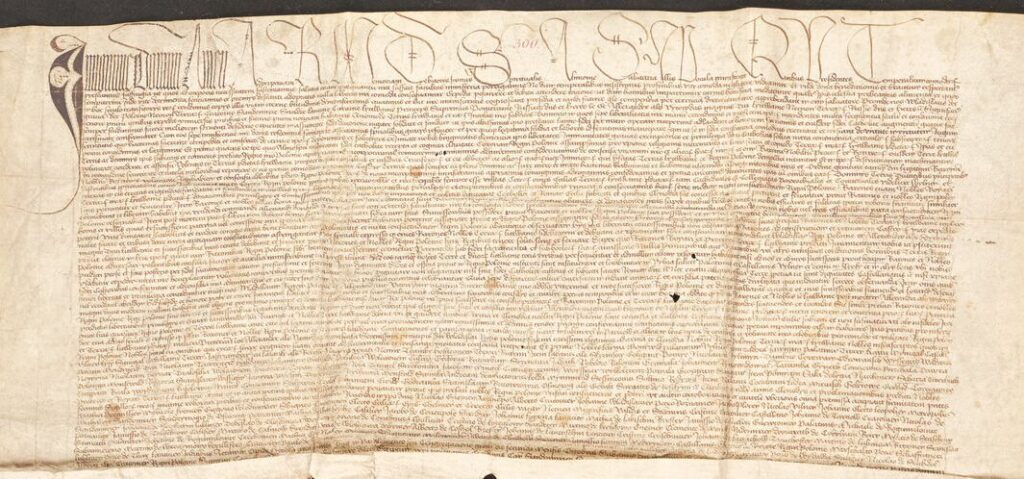
The origins of the MNK Czartoryski Museum archive and manuscript collection lay in the desire to document the public activities of the family members, legal considerations related to conducting court cases and possessing documents that could be presented in court, a passion for collecting, and the desire to create a resource for historians.
The collection comprises over 14,000 reference units containing tens of thousands of documents in loose or bound form.
The following groups of archival materials can be distinguished within it:
The manuscripts are catalogued in accordance with the National Library’s current standards for manuscript cataloguing, in the form of printed catalogues and a computerised catalogue (in MARC 21 format). To date, catalogues of manuscripts have been published for call numbers 1–1681 (S. Kutrzeba, J. Korzeniowski), 1682–2000 (M. Kukiel and A. Homecki), 2001–2300 (J. Nowak), 5214–5441 (J. Pezda and J. Nowak), and two volumes of the catalogue of parchment diplomas (J. Tomaszewicz and W. Szelińska). Some of the valuable Western European illuminated manuscripts have been described in the catalogue (by B. Miodońska and K. Bałus) accompanying the exhibition The Puławy Collection of Illuminated Manuscripts of Princess Izabela Czartoryska (2001). Further catalogues of manuscripts are awaiting publication.
Head: Paweł Wierzbicki
pwierzbicki@mnk.pl