The Collections Department of the MNK Czartoryski Museum comprises artefacts from the collection of Princess Izabela Czartoryska, which was established in Puławy at the turn of the 18th and 19th centuries and which brought together national relics and works of art linked to the culture, tradition and history of Poland and Europe. The collection was significantly enriched by the eminent collector, Prince Władysław Czartoryski, who lived in Paris (since the family’s emigration following the November Uprising of 1830, the Hôtel Lambert had become the MNK Czartoryski Museum’s residence). It is to him that we owe the return of the collections to Poland and the establishment in Kraków of the MNK Czartoryski Museum, which opened in 1876. Looted by the Nazis and subsequently recovered, the MNK Czartoryski Museum collections—which, by law, were not subject to nationalisation—were transferred in 1950 as a deposit to the National Museum in Kraków. In 1991, the properties and the museum and library collections – in accordance with the wishes of the heir, Prince Adam Karol Czartoryski de Borbón-Orléans – became the property of the MNK Czartoryski Museum Foundation. Purchased by the Polish State in 2016, they became the property of the National Museum in Kraków under an agreement dated 21 June 2017.
The collection of the Collections Department of the MNK Czartoryski Museum is a closed collection and is organised into groups: artefacts of ancient art, European painting, sculpture and decorative arts, together with the armoury and prints held in the Prints and Drawings Room.
Individual groups of objects can be counted among the most valuable in Polish museum collections.
Objects of ancient art represent the development of Egyptian, Greek, Etruscan and Roman cultures and demonstrate their mutual influences. Among the numerous everyday objects, the Egyptian and Etruscan sarcophagi, fragments of papyri containing texts from the Book of the Dead, Greek black- and red-figure vases, fragments of Pompeian frescoes, a Medici-type sculpture of Venus, and two mummy portraits – outstanding examples of ancient painting on wood – are particularly noteworthy. A rare item is an Etruscan bronze mirror with a relief depiction of Prometheus.
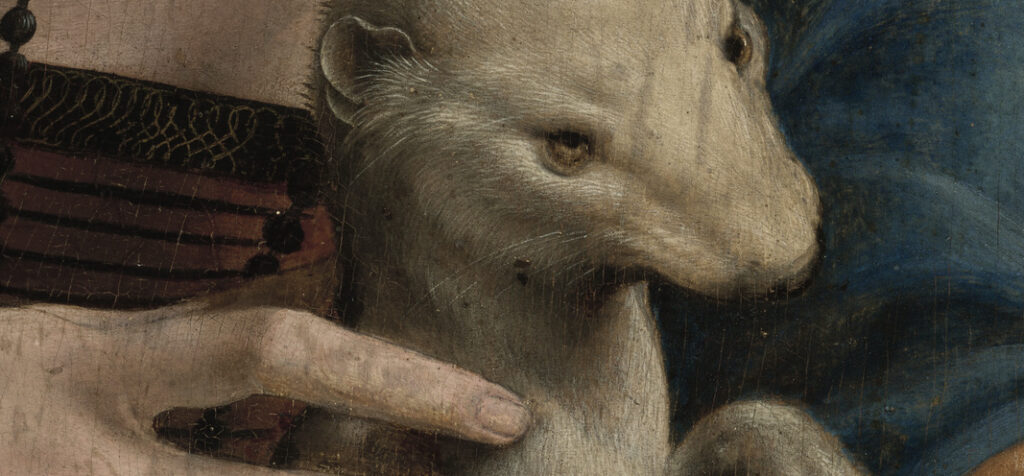
The most valuable artefacts in the collection of paintings and sculpture are: Leonardo da Vinci’s Lady with an Ermine (c. 1490) and Rembrandt van Rijn’s Landscape with the Good Samaritan (1638).
The collection of paintings offers an opportunity to view works created from the Middle Ages to the 19th century, with individual examples forming groups that illustrate the activities of Western European and Polish workshops producing both sacred and secular themes. Of exceptional value are the Italian Gothic and early Renaissance paintings, which include, amongst others, Madonna and Child by the Master of the Poor Clares (Siena, late 13th century). Given the historical nature of the Puławy collection, portraits of famous figures occupy a significant place, such as the miniatures of the Jagiellonian family from the workshop of Lucas Cranach the Younger (c. 1490). The family aspect of the collection is further emphasised by portraits of family members.
The collection of artistic crafts includes both objects of high artistic and historical value associated with figures of distinction in Polish and world history, as well as items of a commemorative and relic nature. Valuable collections include ivory works – creations by Byzantine, French, German and Italian artists from the 11th to the 18th centuries – as well as medieval and Renaissance enamels, mainly from the Limoges workshops, but also from Lorraine and Catalonia. Also represented are Renaissance Italian and Spanish-Moorish majolica, Meissen porcelain, early Venetian glass, textiles and carpets, and Oriental art, mainly Persian and Turkish. A valuable group of artefacts comprises Polish and foreign medals and a collection of Polish coins. The armoury, mostly from the Puławy collection, includes the weapons of kings and hetmans, war trophies, the symbolic insignia of commanders, maces and battle-axes, and sabres acquired from the aristocratic families of the Lubomirski, Potocki, Radziwiłł, Sapieha and Zamoyski. The collection also includes mementoes of kings from the Crown Treasury at Wawel, Turkish trophies taken at Vienna in 1683, as well as items associated with Tadeusz Kościuszko and Prince Józef Poniatowski. Among the Western European artefacts, a collection acquired from the Imperial MNK Arsenal in Vienna and the Brussels MNK Arsenal stands out.
The collections of the Department of Prints and Drawings include artefacts depicting portraits of Polish and foreign figures, engravings on historical and religious themes, as well as views of Polish and foreign towns and cities. The collection houses works by artists such as Jacques Callot, Stefano Della Bella and Jan Piotr Norblin.
Of particular value are examples of Italian prints from the 15th and 16th centuries, a collection of prints by the Antwerp Mannerists, as well as prints by Albrecht Dürer, 12 large landscapes after Pieter Bruegel the Elder, and Rembrandt’s Landscape with Three Trees. A separate group consists of foreign drawings, such as Gerard David’s Three Women’s Heads, or works by Pieter Bruegel the Elder, Giandomenico Tiepolo and others. The collection also includes architectural plans, including those related to the conversion of the townhouses on the corner of St John’s and Pijarska Streets, the former Piarist monastery, and the MNK Arsenal into the complex of buildings comprising the MNK Czartoryski Museum and Library.
Head: Dr Katarzyna Płonka-Bałus
Curator of the MNK Czartoryski Museum
tel. 797 029 934